Article
Optimise your solar power production
Sowel is the energy brain of your home: it shares the surplus from your solar panels between your appliances in real time.
In this article
Your water heater, your car, your heat pump and your pool all want to use that solar electricity. If each appliance watches the meter and starts as soon as there is a surplus, the system fails for a simple reason: they all read the same meter, start together and fight over the same watts.
Adding priorities is not enough: sharing a surplus that never stops moving takes algorithms that are hard to tune.
Sowel solves this differently: it centralises the decisions about energy and decentralises the control of each appliance. One arbiter shares out the surplus, and each automation asks it for its share while remaining in charge of its own appliance.
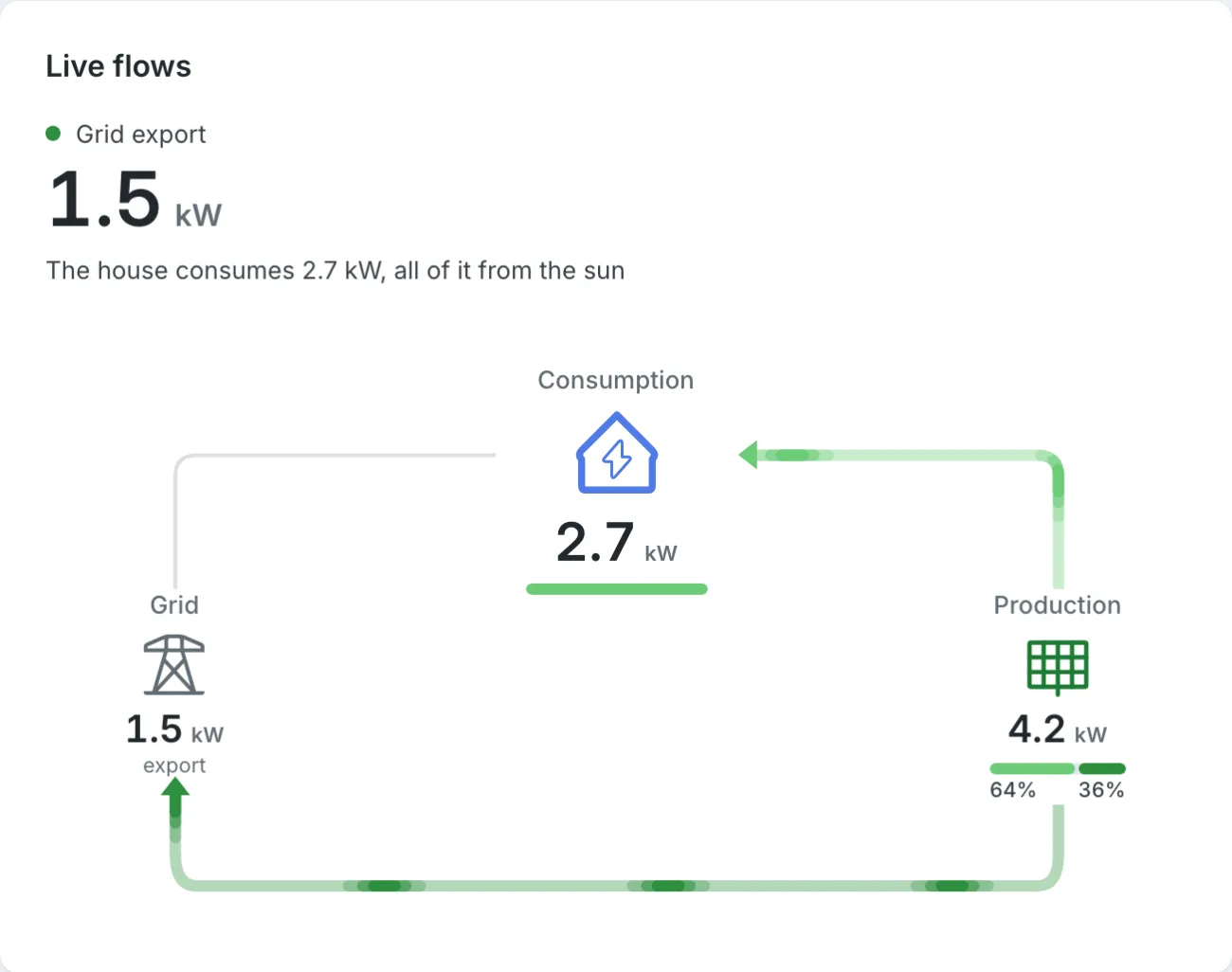
The solar surplus never stops changing. A cloud passes, production collapses, then comes back. A rule like "if I export more than 500 W, switch on" flips with every cloud.
Switching on a load changes the surplus. As soon as the water heater starts, the export disappears. A simple rule concludes the sun has gone and switches the heater off; the export returns, the rule switches it on again, and the water heater yo-yos.
Appliances do not obey at once. A water heater keeps drawing power for several minutes after it is told to stop, and can restart by itself during off-peak hours.
Rated power is not real power. A device rated at 650 W sometimes draws 530. Counting on the rated power means misjudging the surplus that is really left.
Several uses fight over the same surplus. Water heater, car, heat pump: with no common order, the most impatient automation wins.
There are two usual answers, and both fall short. The first, a threshold and a timer per appliance, fails as soon as two loads go after the same surplus: each assumes it has the surplus to itself, and they all start together.
The second, a priority controller, has the right idea but is hard to build well. The algorithm has to hold everything at once: priorities, minimum on and off times, import tolerance, loads that are slow to stop. And every new use of the surplus means declaring and tuning everything again.
Conventional home automation, with its scenes and, at best, some priority handling, was not designed to absorb that much complexity. Sowel is built for it from the start.
All of Sowel's automation rests on recipes. A recipe is a ready-made automation: you install it from the app's catalogue, assign it to a zone of the house, answer a few questions, and it runs. "Light on motion" or "heat the water with the sun" are recipes.
When a recipe touches energy, it can talk to the energy arbiter. It does not take the surplus: it asks for it. "I need 550 W."
The arbiter reads the main meter continuously, shares the available surplus among all the loads according to the priority order you set, and answers each recipe with "granted", "waiting" or "revoked".
One brain for energy, one expertise per appliance.
That is Sowel's principle. The energy decisions are centralised in the arbiter, which sees the whole house and decides who gets the surplus. The control is decentralised in the recipes, each one an expert in its appliance.
The water heater recipe closes its contact when the arbiter grants it the surplus, hands it back when the water is hot and re-arms after a delay that doubles each time it is withdrawn. The charger recipe sets the current, guarantees a minimum charge at departure using off-peak hours and takes over a charge that started on its own. None of them has to solve how the surplus is shared: each leaves that to the arbiter and keeps the expertise for its own appliance.
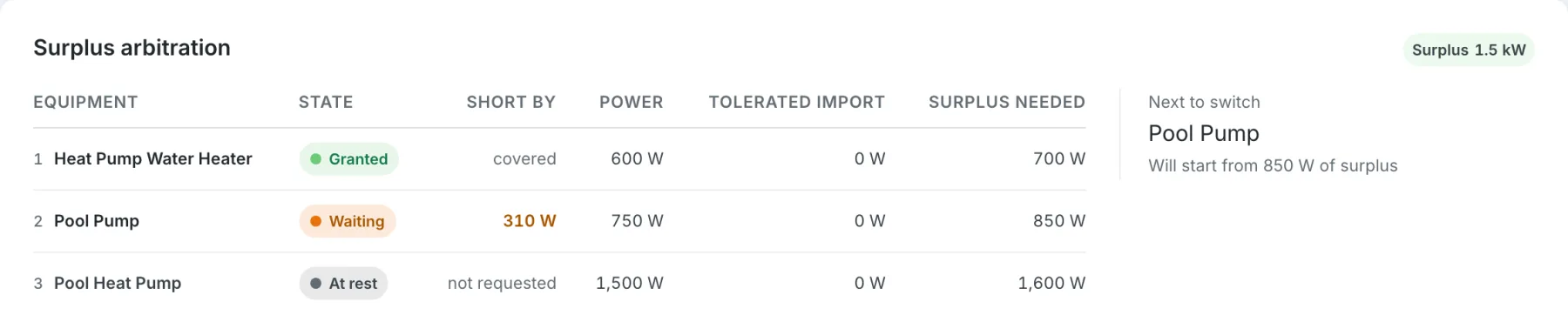
What sets the arbiter apart:
- It decides for the whole house, in one place: loads no longer fight over the surplus.
- It learns the power each load really draws, instead of trusting the power the manufacturer states.
- It also counts what it does not control: the rest of the house consumes, and it knows.
- It keeps counting the power of a withdrawn load until its shut-off delay ends, so it does not treat that power as free too early and withdraw the next load by mistake.
- If you allow it, it accepts, load by load, a little grid import to finish a cycle, but no more.
- It adjusts the car charger ampere by ampere, as close to the surplus as it can.
- When the surplus drops, it first reduces what can be reduced, then withdraws the lowest-priority load. It never cuts a comfort load.
- It writes every decision and its reason in a journal: you know why the water heater did not start a moment ago.
For a new use of the surplus, you install a recipe and give it its place in the priority order. It brings the control of its appliance; the arbiter gives it its share. No global configuration to rework.
This division of roles is what sets Sowel apart. None of the systems we examined lets installable recipes talk to a common energy arbiter, or adds a new use of the surplus simply by installing one.
- It does not yet take weather forecasts or prices into account: it reacts to the surplus it measures.
- A load's shut-off delay is a setting you choose: it does not learn it yet.
Sowel is free software and runs on your own hardware. The water heater and EV charger recipes install from the app's catalogue, and the manual covers the arbiter and its settings.